 Nestronics
Nestronics
Nestronics
Naturally occurring element. Selenium is incorporated into selenoproteins, such as glutathione peroxidases (GPxs) and thioredoxin reductases (TrxRs), which play critical roles in protecting cells from oxidative damage.
Involved in GPx, TrxR, ans Selenoprotien P which protect normal cells from oxidative stress.
Important in Thyroid hormone metabolism, immune system regulation, reproductive health, and Brain and heart protection.
-recommended daily allowance (RDA) for selenium is about 55 µg/day for adults. (upper tolerance 400ug/day)
-One Brazil nut may contain 50-300ug/nut
Sodium selenite (Na₂SeO₃) is a selenium compound with well-documented anticancer and chemopreventive properties
-Oxidation state: +4 (selenite form of selenium)
-Type: Inorganic selenium compound (water-soluble)
-Sodium selenite generates reactive oxygen species (ROS) selectively in tumor cells.
-Induces cytochrome c release, caspase-3 activation, and DNA fragmentation.
-Reduces VEGF expression and endothelial cell migration.
-Blocks cell division at G2/M phase
-Suppresses MMP-2 and MMP-9 activity
-Activates p53
-Inhibits NF-κB
-PI3K/Akt/mTOR Suppression
-Inactivation of Thioredoxin/Glutathione systems
-NRF2 inhibition in cancer cell might be connected with O2 level
Narrow therapeutic window:
-Low micromolar (≤5 µM) → anticancer
-High (>10 µM) → toxic to normal cells
Some Selenium Supplements use Sodium Selenite as the active ingredient.
- NOW Foods Selenium, Nature's Bounty Selenium, etc
Other common form is Selenomethionine, as it is better absorbed (found in brazil nuts),
but might be less effective?
Sodium selenite might protect against toxicity
of AgNPs(silver nanoparticles).
also here
SeNPs might be hepatoprotective.(Liver)
Selenium nanoparticles (SeNPs) are a biocompatible, less-toxic,
and more controllable form of selenium compared to inorganic salts (like sodium selenite).
Major SeNPs hepatoprotective mechanisms
Mechanism	              Description	                       Key markers affected
1. Antioxidant activity	      SeNPs boost antioxidant enzyme          ↓ ROS, ↓ MDA, ↑ GSH, ↑ GPx
                              systems (GPx, SOD, CAT) and scavenge
                              ROS directly.
2. Anti-inflammatory effect   Downregulate NF-κB, TNF-α,              ↓ TNF-α, ↓ IL-1β, ↓ IL-6
                              IL-6, and COX-2 pathways.
3. Anti-apoptotic action      Balance between Bcl-2/Bax and reduce    ↑ Bcl-2, ↓ Bax, ↓ Caspase-3
                              caspase-3 activation in hepatocytes.
4. Metal/toxin chelation      SeNPs can bind or transform toxic       ↓ liver metal accumulation
                              metals (Cd²⁺, Hg²⁺, As³⁺)
                              into less harmful complexes.
5. Mitochondrial protection   Maintain membrane potential,            Preserved ΔΨm, ↑ ATP
                              prevent mitochondrial ROS burst,
                              and ATP loss.
6. Regeneration support	      Stimulate hepatocyte proliferation      ↑ PCNA, improved histology
                              and repair via redox signaling
                              and selenoproteins.

Comparison: SeNPs vs. Sodium Selenite
Property	             SeNPs	                   Sodium Selenite
Toxicity	             Low	                   Moderate–high
Bioavailability	             Controlled, often slow-       Rapid, less controllable
                             release
ROS balance	             Adaptive, mild antioxidant	   Can flip to pro-oxidant easily
Safety margin	             Wide	                   Narrow
Hepatoprotection	     Strong, sustained	           Protective at low dose,
                                                           toxic at high dose
Below is shown one method of making Selenium Nanoparticles using Ascorbic Acid as a reducing agent. Mix at 250RPM 80mL of Distilled Water with 1/64 tsp of AA (Ascorbic Acid/ Vitamin C).
Let mix for 2 minutes. Then add 100ug of liquid Selenium in the form of Sodium Selenite. This selenium solution is available from
Allergy Research Group, and other places. Typically 1/2 teaspoon is 100mcg. Let mix at 250RPM for 30 minutes. The color will change slighty yellow/brown,
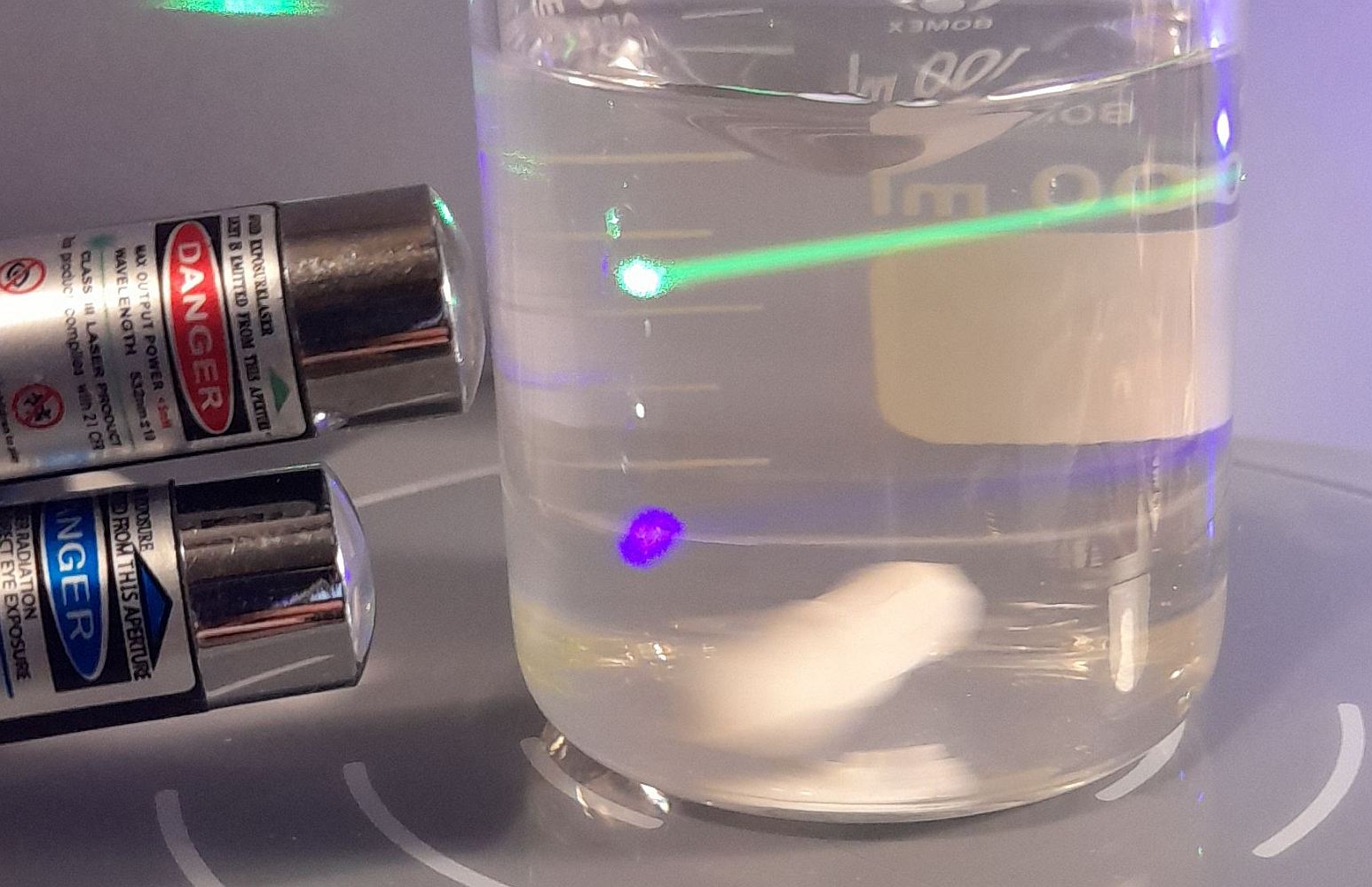
and more importantly the green and violet lasers pointers will clearly show the presence of the nanoparticles.
The bright green laser for SeNPs shows fairly large SeNP of perhaps 100nm. This is also indicated in the color of batch.
Running the batch for a shorter time (for immediate use) will create smaller particles (which is usually desirable). Perhaps when slight color change is visible,
and the green laser starts to show. This might be 5 minutes, but that depends on the starting pH. The starting pH of
distilled water will vary depending on how old the distilled water is. I have noticed with old distilled water(lower pH) the Ascorbic
Acid does not appear to dissolve right away (if at all) and form ghostly swirls instead. This is undesirable.
Here is an AI guessimate of Se nanoparticle size vs time:
Time after mixing    Likely dominant size
   1–5 min              ~5–20 nm
   10–30 min            ~20–80 nm
   1–2 hr               ~80–200+ nm
   Overnight            Aggregates / broad distribution